The Youngest Daughter: The Unseen Truth-Seer
Note: The use of the words daughter, girls, or women are intended to include anyone who may no longer or only partly hold that identity but were socialized within that gender identity and, therefore, potentially internalized harmful messaging associated with that gender.
I want to expose the youngest daughter in immigrant families, which honestly is probably their worst nightmare. I’ve been seeing so much about eldest daughters, and while they definitely deserve their due, all of the other daughters in the system do, too.
Anyone who’s a child of immigrants knows that typical birth order stereotypes don’t always apply—especially when we take a closer look at gender. In particular, for the youngest daughter, the typical “baby” and “favorite” labels don’t apply here, even if our elder siblings seemingly think they do.
It’s no secret that our elder siblings may have fought or started certain battles before us, but what often doesn’t get recognized is the battles we’ve had to fight on our own, all while cleaning up the wreckage of past battles.
Youngest children come into systems that are already built and functioning, and there, usually, isn’t any space left to take up. What people don’t realize though is that entering an already well-oiled system allows us to see the whole picture—especially the cracks. As girls and women, we are expected to to fade into the background and serve the needs of the system, so as the youngest daughters, we instinctively try to be that invisible glue, filling in those cracks.
But the reality is that we are only one person, and there are entirely too many cracks. The foundation has been cracking long before us.
When the movie Encanto came out, children of immigrants everywhere felt so incredibly seen. Despite everyone talking about this movie, what I never saw anyone talk about was Mirabel’s role as the youngest daughter. Our invisibility dynamic was evenplaying out in public discourse.
Isabela was the perfect eldest daughter that was never given permission to be herself.
Luisa was the strong middle child, but “under the surface,” there was a hunger to be: noticed, appreciated, and able to put the burden down. Although this piece isn’t about the middle children/daughters, as a youngest daughter who sees and honors the whole system, I want to take a minute to acknowledge their role. Typical middle children tropes name someone who was neglected and crying out for attention that they deserved. They depict the rebel or a cycle-breaker that is so often unfairly scapegoated. They too entered into a system that was already functioning, and they had to find a way to create space for themselves. While Encanto didn’t quite say this explicitly, it takes a lot of strength to be the middle child.
Now, enter the youngest daughter. I don’t think it was any coincidence that Mirabel wasn’t given a gift; those gifts—or roles—were already taken up. Instead, she was expected to be a chameleon and invisibly support her elder sisters—and all of the elders—in their contributions. Instead, she was expected to perfectly fade into the background, strongly bearing all of her emotions and needs on her own. She didn’t have to take on just one role; she had to take them all on.
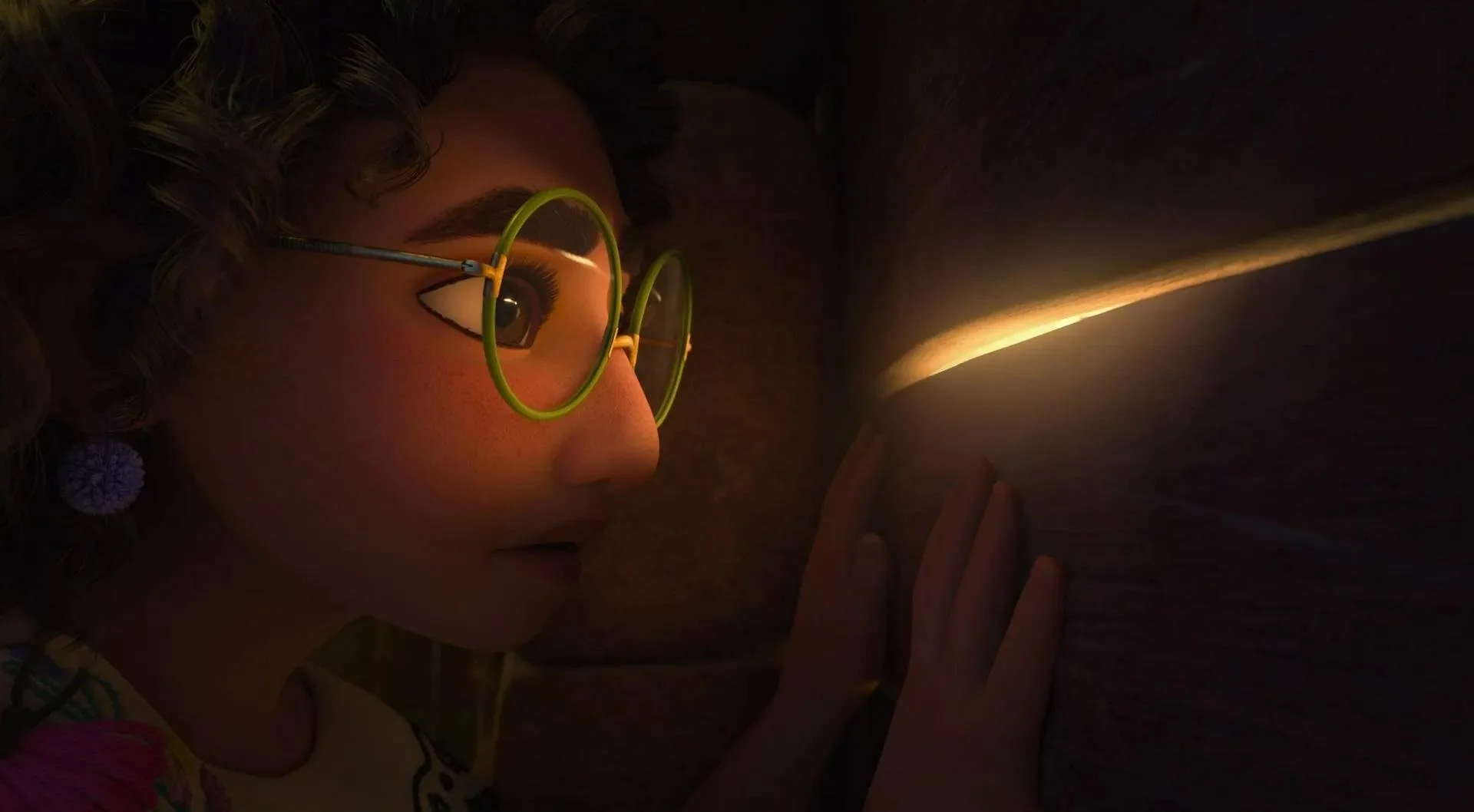
Mirabel from Encanto peering through a crack.
But again—she was the only one who could see the cracks, all the while still trying to fill them on her own. Along the way, she helps her sisters realize that they don’t have to take up the mantles they’ve been forced into, and Mirabel realizes that if each of them doesn’t do what they’re expected, the miracle actually shines brighter.
She also realizes that any way that she tries to help her family—whether it’s being the invisible supporting character or the one who’s breaking cycles—she will never be enough. And even if it felt like her sisters were also making her feel that shame, she was able to recognize that her sisters bear that burden of shame, too.
Youngest daughters are only seen as “the favorite,” when we’re not only doing exactly what we’re expected to do but going ABOVE AND BEYOND that. However, we’re just as easily scapegoated when we don’t.
Because Mirabel could see the cracks and started calling attention to them (and herself), she was gaslit into thinking that the cracks weren’t real or that they were of her own doing. Like Bruno, the youngest triplet in the generation before them, they were crazy-made and ostracized. Bruno was the truth-seer that attempted to hold up a mirror and was exiled, all the while quite literally being in the cracks of the walls quietly and invisibly supporting his family. Mirabel literally tried everything she possibly could to prevent the miracle from dying, including digging up the family’s biggest secret in their walls, but even that wasn’t enough. Instead of being celebrated, she was vilified.

Mirabel from Encanto holding the prophecy that was broken.
Ultimately, Mirabel forced her family to look into the mirror, shattered every illusion, and brought the whole system crashing down. She is the epitome of a cycle-breaker. Her gift was being able to see the entire system AND being able to recreate it for the better.
In reality, the care-taking and cycle-breaking done by the youngest daughters isn’t always quite as loud. In fact, it’s usually invisible.
Instead, it’s having empathy for our siblings’ burdens, even when they perpetuated harmful cycles with us. It’s choosing our battles, knowing when it’s time to speak up or protest silently. It’s illuminating dysfunctional family dynamics that our siblings couldn’t quite see and championing change through example. It’s educating and reparenting ourselves AND our parents. It’s taking care of our elderly parents, while our older siblings become parents. It’s being the aunt that shows our niblings different possibilities and caring for them like they’re our own. It’s refusing to follow the path that’s been laid out for us.